Free lesson · no signup
Try a free French lesson, explained in your language
Start the real course now — Episode 1 plays after two taps — or try a 5-minute sample lesson right here, with explanations in English, Hindi or Punjabi.
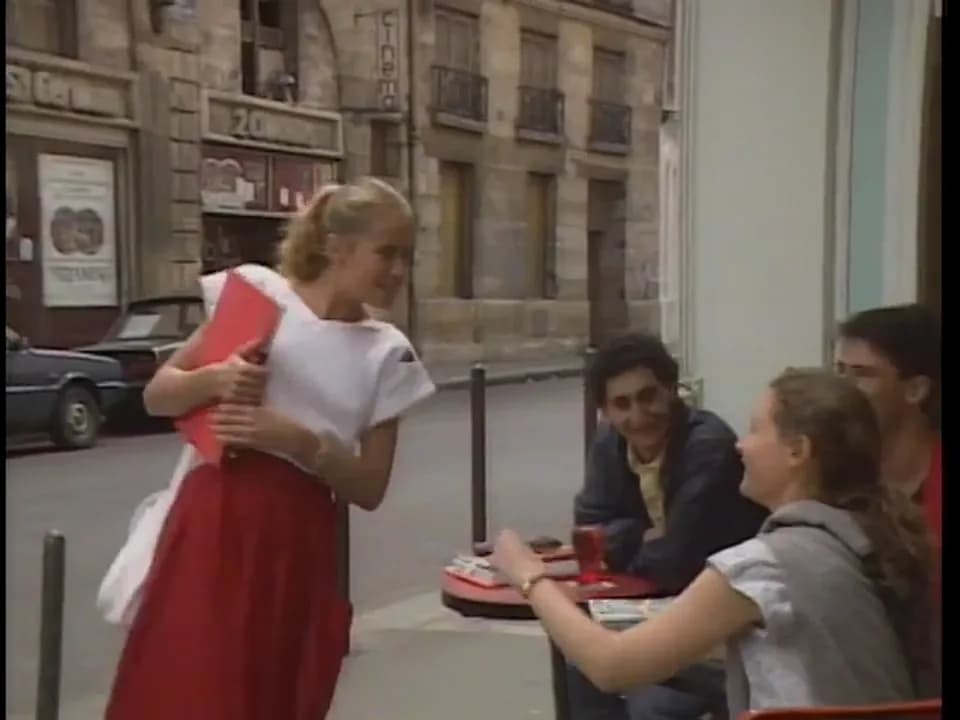
The full course · Episode 1
Watch Episode 1 free
Orientation · 32 min video · CEFR A1
The first episode of French in Action, the 52-episode story course this site is built on. You learn bonjour, salut and je m'appelle, with Hindi and Punjabi pronunciation help and tap-to-translate subtitles.
2 taps · no signup · no card
5-minute sample lesson: Meera orders a coffee
Listen to a short café conversation in Montréal, learn five words and answer three questions. Everything works in your browser.

Step 1 of 3
Listen to the conversation
Meera orders a coffee in a Montréal café. Press play, then tap “Explain” on any line.
Your browser can't play French audio. Read the lines and the explanations instead.
- Meera
Bonjour ! Un café au lait, s'il vous plaît.
Hello! A coffee with milk, please.
“S'il vous plaît” means please. It is polite, like adding “ji”.
- Julien
Bien sûr ! Vous n'êtes pas d'ici, vous ?
Of course! You're not from here, are you?
“Vous” is respectful (like आप), “tu” is casual (like तुम).
- Meera
Non, je viens de Ludhiana, en Inde.
No, I'm from Ludhiana, in India.
“Je viens de…” means “I come from…”. You will use it in your TEF or TCF speaking introduction.
- Julien
Ah, l'Inde ! Bienvenue à Montréal.
Ah, India! Welcome to Montréal.
Our lessons use Canadian French, the accent you will hear in TEF and TCF Canada audio.
How are CLB French lessons taught?
Each lesson is one episode of French in Action, a story filmed in Paris and told entirely in French. You warm up with the key phrases and their pronunciation in Hindi and Punjabi script, watch the episode with tap-to-translate subtitles, learn the words and patterns behind it, then practise with quizzes, dictation and speaking and writing tasks with AI feedback. The sample lesson on this page follows the same listen, words and practice steps in five minutes.
Sample lesson or Episode 1: what is the difference?
Both are free. The sample lesson shows the method in five minutes; Episode 1 is the real course.
| Sample lesson | Episode 1 | |
|---|---|---|
| Length | About 5 minutes | 32 min video, plus optional practice |
| What you get | A café dialogue, 5 flashcards, 3 questions | Warm-up, the full video, words and patterns, practice |
| Audio | Your browser's French voice | Original recordings with native speakers |
| Help in your language | Line-by-line explanations in English, Hindi or Punjabi | Hindi and Punjabi pronunciation, tap-to-translate subtitles |
| Account | None | None to start: 2 taps, then add your email later to keep your progress |
Why learn French with Hindi or Punjabi explanations?
French and Hindi or Punjabi share ideas English doesn't: vous and tu work like आप and तुम / ਤੁਸੀਂ and ਤੂੰ, and every noun has a gender, like in Hindi. Seeing French through the language you think in makes these patterns click faster. In the full course, key phrases also come with their pronunciation written in Devanagari and Gurmukhi.
Which level is this lesson, and how far is NCLC 7?
The sample lesson and Episode 1 are both A1, the first level of the CEFR scale (A1, A2, B1, B2). Express Entry French draws ask for NCLC 7 in all four skills, which is roughly CEFR B2. Read how the levels compare, or take the 10-minute level test to see where you would start.
What happens after this lesson?
In the full course, each episode adds new scenes, words and grammar, and your plan adds TEF and TCF Canada practice. Take the level test to see where you would start.